
Practical Compliance Guide: How to Properly Store and Package Industrial Waste
To support our business partners in optimising their waste storage areas, the Metais Jaime Dias technical team has prepared this practical guide with the main legal requirements for correctly packaging and storing materials, with special focus on hazardous fractions.
1. General Best Practices for Waste Packaging
The temporary waste storage area in your company must have a clearly identified space and a waterproofed floor, absolutely preventing contamination of the soil and groundwater. In accordance with current legislation, the following criteria must be ensured:
Protection and Control: Storage areas should preferably be covered, well ventilated, and equipped with suitable access for loading/unloading movement and operations. Access to this location must be restricted to authorized personnel.
Priority on Recovery: Continuous measures to prevent waste generation must be adopted, always prioritising reuse and recycling over final disposal.
Source Sorting: It is mandatory to ensure the correct separation and sorting of waste generated directly at the production site itself.
Accurate EWC Classification: All waste must be correctly classified according to the European Waste Catalogue (EWC). Whenever necessary, the Safety Data Sheets (SDS) of the original products must be consulted to determine whether the resulting fraction has hazardous characteristics.
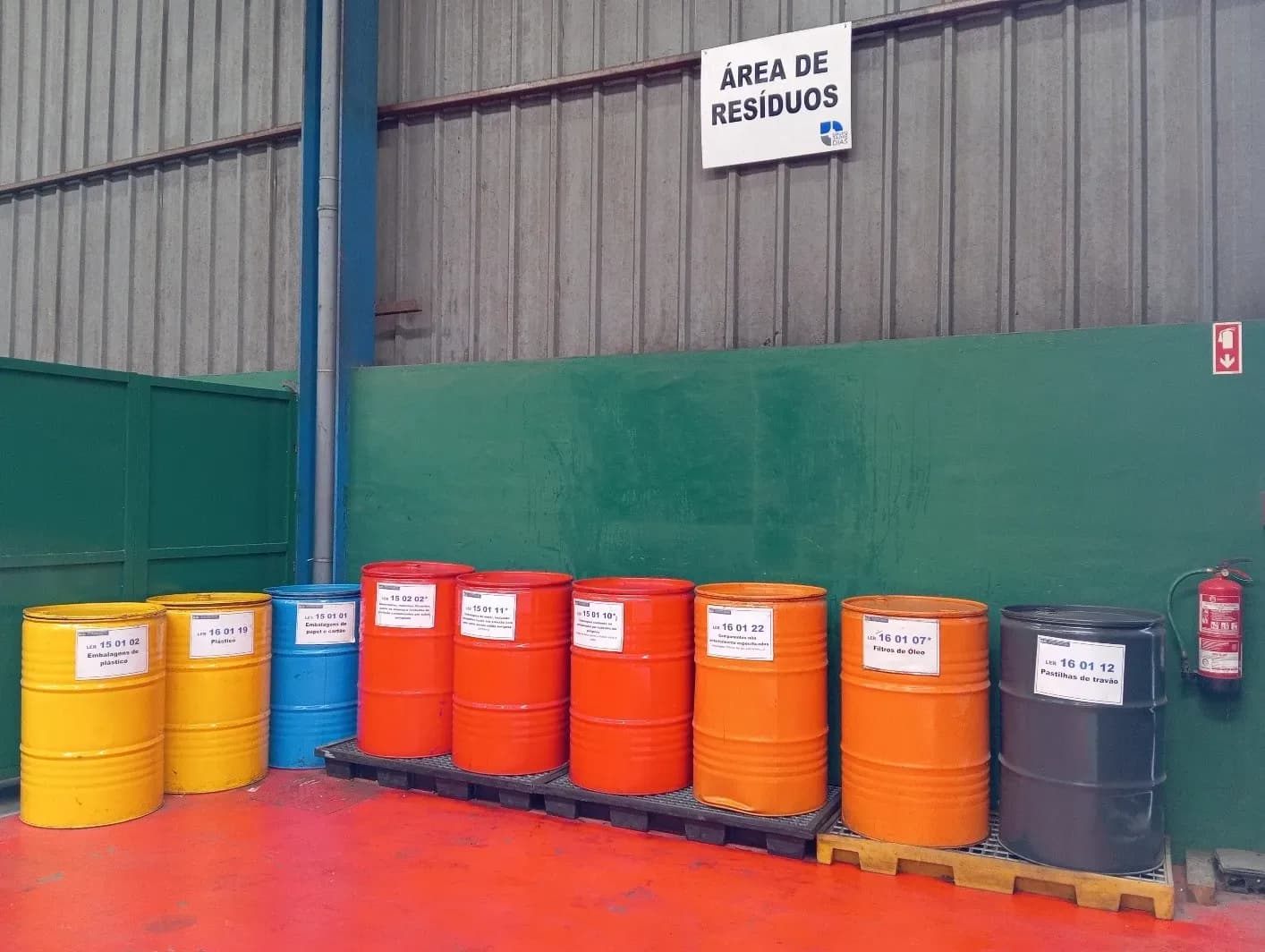
Proper Packaging: Ensure that each type of waste is placed in appropriate, watertight packaging, avoiding spills or improper mixing.
2. Critical Requirements: Hazardous or Contaminated Waste
The storage of hazardous waste or materials contaminated by hazardous substances requires extra care. In these cases, the site must have a dedicated containment area and strictly comply with the following legal requirements:
Isolation and Ventilation: A space that must be covered and ventilated, with physical barriers and strict access control to prevent entry by unauthorized persons.
Absolute Watertightness: Use of fully watertight containers equipped with waterproof containment basins, sized to retain any spills, leaks, or leachate, eliminating any risk of environmental contamination.
Advanced Drainage: Installation of a drainage and contaminated liquid collection network directed toward proper subsequent treatment, including mandatory hydrocarbon separator systems.
Segregation by Chemical Compatibility: Waste must be properly labeled, identified, and strictly segregated according to its specific flammability, reactivity, and corrosiveness characteristics. This organisation is vital to avoid dangerous chemical reactions resulting from incompatibility between different materials.
Need Support Organizing Your Company's Waste Storage Area?
At Metais Jaime Dias, we simplify your business's environmental management. We provide our clients with complete packaging solutions, including certified industrial containers (ranging from 2m³ to 80m³), Big Bags, specific drums, and containment basins for the safe storage of batteries and hazardous waste.
We ensure efficient collection throughout the northern region of the country, guaranteeing full traceability of materials and the documentary support required for submission to official platforms (SILiAmb/MIRR).
Talk to our environmental engineering team and request a management plan tailored to your industry.
Share this article